

Kwik Trip’s Long Road Ahead
PROTOCOL: PROSPECT_IP
REF: PROSPECT_KWIK_TRIP
RESULT: HIGH_RISK_HIGH_REWARD
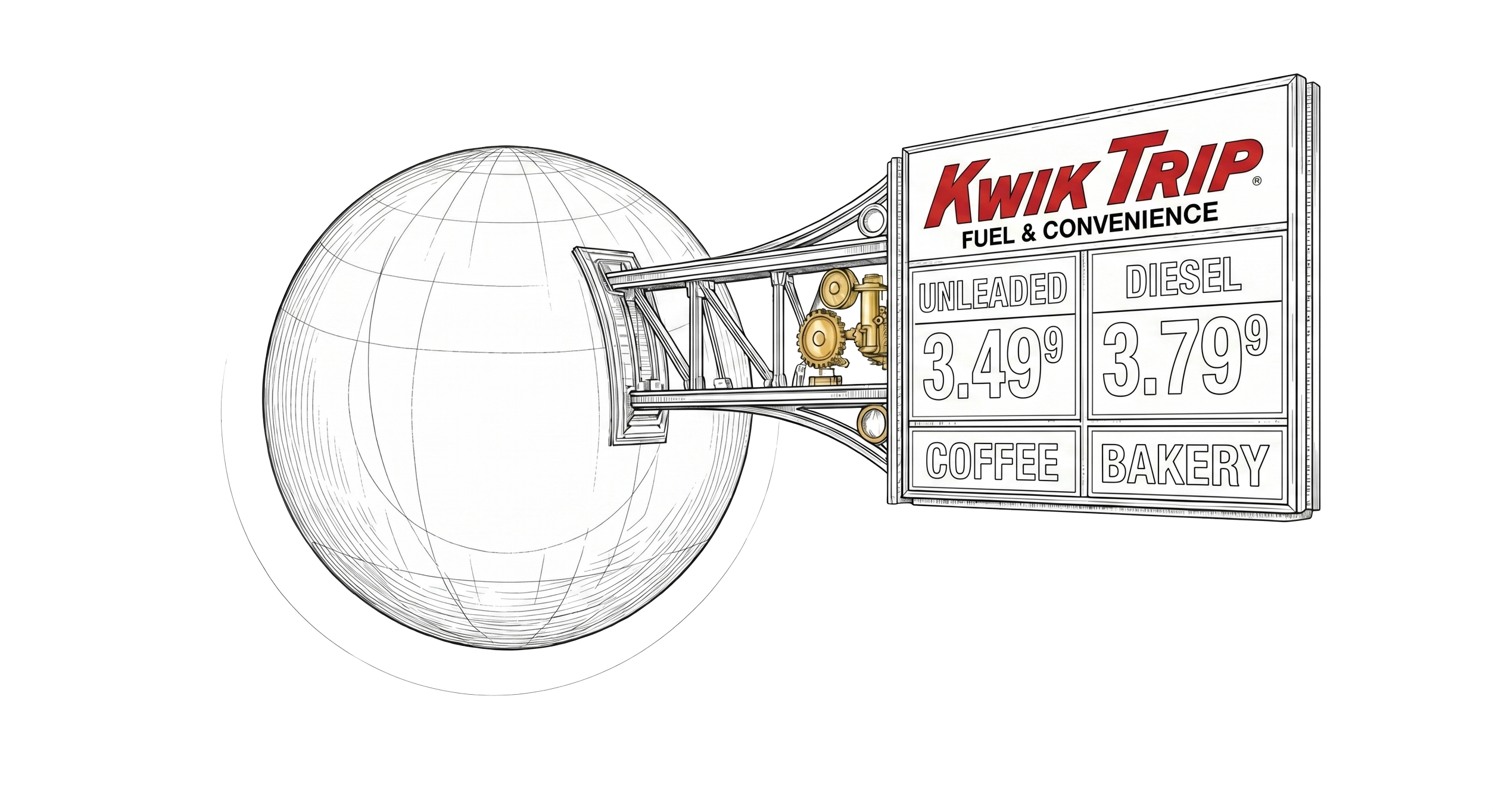
Kwik Trip’s regional dominance is likely to continue, but the company faces the invisible culture walls shaping the American sociological landscape. Framing Kwik Trip’s competitive edge as their “cultural integration” makes the difficulty of crossing those barriers harder. Less defined brands can go broad but as any standup knows, “local jokes get local gigs.” Has Kwik Trip booked themselves to forever sell out Midwest shows or is there a way they can develop their IP into a nationally recognized semiotic for “quality” on the roadside?
Prospect Report
ROUTE A: Business as Usual
Kwik Trip’s leadership leans on their regional momentum to push through the cultural boundaries. They continue their slow, steady expansion town-by-town like a glacier.
ROUTE B: Expanding the Brand
Kwik Trip aims for a broader interpretation of their brand, looking to translate Midwestern semiotics into a competitive brand outside the region. They keep key elements while broadening their stock to meet varied demand.
ROUTE C: Regionalizing the Brand
Kwik Trip takes its regional model of vertical + cultural integration from La Crosse, WI and sets up mirrored hubs across the U.S. with satellite brands. They share some infrastructure and regionalize customer-facing semiotics.
CONSUMPTION IS AFFECT-driven
While convenience stores might not strike most people as IP, you certainly aren’t shopping at Shell over BP because the gas is different. Even if it is (and it isn’t) could you explain why? Despite the factual grounding, most Americans have a preferred gas station: it’s the illusion of choice fallacy. Whether we’re talking about gas stations or breakfast cereals, the material differences in the products are so slight (if extant at all) that the branding is what people are buying. That affective resonance – the current emotional need and the predicted emotional state after engaging with the product – is what people actually buy. That also means “quality” isn’t an objective measure: it’s a question of preferences, norms, and expectations. Companies sell a feeling and they use the physical materials to do it.
Kwik Trip has mastered the emotional tete-a-tete with Midwestern drivers. Wide-open parking lots, spacious aisles, and a wall of hot foods always visible from the entrance aren’t accidents. These are clear cultural symbols that invite people in, encourage them to stay in a space that feels transient, and makes busy travelers feel like welcomed guests. Those feelings are universal but how you trigger them is entirely dependent on culture and the individual in question. Where Midwestern families might find fried cheese curds an easy solution for picky kids, the calories and dairy content keep it being considered along the Pacific Coast. Even the taller-than-normal shelves are a design decision with Midwesterners in mind: tall towers give a sense of privacy that conveys trust. Most other gas stations keep shelves low enough that attendants on their slightly elevated platform can keep an eye on everything. That kind of surveillance translates as suspicion rather than practicality in the Midwest.
Betting on Kwik Trip’s continued success is wise. They’ve announced hundreds of store expansions across multiple states from the Midwest’s core (IL, MN, WI, MI) to its periphery (ND, SD, OH, MO) with no signs of slowing down. It will be a few years before the invisible culture wall starts to show itself. If Kwik Trip’s leadership hits that wall without having a ready-to-deploy strategy, that wall will become a permanent barrier. They might achieve mythic status in the Midwest, but that will forever be the limit of their story’s reach. If they want to break through and become the household name for gas stations across America, they need to start investing in those strategies today. C-suite leadership tends to keep plans close to their chest and there’s been no signaling from Kwik Twip’s executives that they’re pushing a national strategy any time soon. Whether they have national ambitions or are happy owning their piece of the total national market is pure speculation on my part but they are an American company. It’s fair to assume growth will always be the goal.
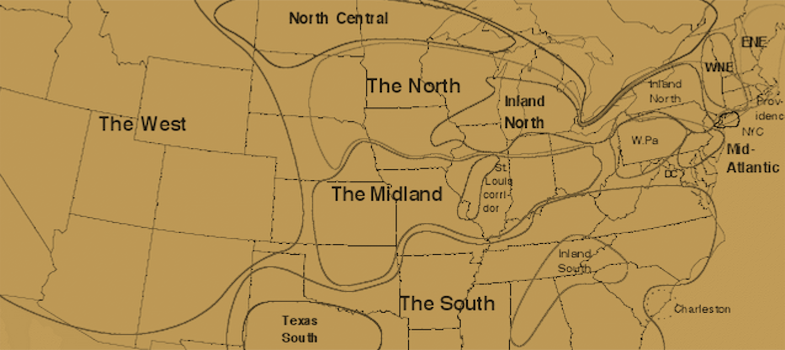
REGIONAL TRIBALISM: America’s invisible wall
There’s no shortage of maps breaking America into different regions, some silly and some very serious. The New York Times’ dialect quiz and its various copycats prove what sociologists have long understood about the U.S.: we truly are many people united under a shared name. Just looking at the geographical variety of the U.S. explains it. Some parts of the U.S. plunge below -40C in winter while others never go lower than 10C. We have sprawling desert lowlands and some of the oldest mountain peaks on Earth. You can find vast forests, rolling plains, and frozen tundra all in the same country. Now layer onto that 400 years of migration from every single continent, thousands of years of Indigenous history, and the domestic conflicts between the different States and you can start to see how many different “American” cultures there really are.
Each region has its own opinions about other regions, including what states (or parts of states) count as part of a given region. Ask me (from Wisconsin) if Missouri is in the Midwest and I’d scoff of the notion of any shared culture between us. Ask someone from California and they probably wouldn’t know which state was which on a map. I’m sure we’d have the same trouble labeling Rhode Island from New Hampshire. We span 3.12M square miles just counting the contiguous U.S. Only the oldest empire in the world (China), an empire of mostly empty tundra (Russia), and our chilly sister-empire to the north (Canada) beat us on size. All three are also largely uninhabited in massive swaths of their landmass (Himalayas in China, the tundras in Russia and Canada) compared to the U.S. with its mostly inhabited map space. Small, rural towns linked by extensive highway infrastructure and the auto industry allow for America’s paradoxical sense of unity and clearly distinct cultures.
For Kwik Trip or any regional brand looking to go national, this paradox forces a change in their key business dynamics. It isn’t simply that Kwik Trip’s business model found a home in the Midwest: it was born and raised to fit the Midwest. Like any transplant, Kwik Trip needs to adapt to its new home. Global companies face this problem constantly: to appeal to “everyone” you need to be universal, but in being universal, you are nondistinct. Apple dropped its edgy upstart energy to become the sleek, international symbol we recognize today to break outside American markets. Disney announced a shift toward “universal” stories that has left their recent originals flopping and forcing the company to return to the IP machine. It’s an impossible position to navigate: be everything to everyone while being entirely distinct from everything and everyone else. In the U.S., our regions are effective mini-nations. Going national here is the easy version of going global.
Narrowing these differences down to driving culture, let’s look at the four major regions and the complex field Kwik Trip needs to navigate. While there are similarities, no two regions are exactly the same and variety within regions exists:
| Category | WEST | MIDWEST | SOUTH | EAST |
|---|---|---|---|---|
| Time - Distance (Urban) | 1 hour = 10 mi | 1 hour = 40 mi | 1 hour = 40 mi | 1 hour = 10 mi |
| Time - Distance (Rural) | 1 hour = 80 mi | 1 hour = 70 mi | 1 hour = 55 mi | 1 hour = 55 mi |
| Commuting | Select urban hubs with public transit. Driving expected. Long distance commutes normal. | Driving expected even in urban hubs. Long distance commutes normal. | Driving expected even in urban hubs. Long commute times expected with relatively short distances (urban sprawl) | Urban areas developed transit infrastructure. Rural areas expect cars but have access to trains for longer distance options |
| Driving Necessity | Walkable cities are rare and alternate modes of transportation between urban centers is limited or largely nonexistent. | Walkable cities are rare, with even small towns requiring cars for basic errands. Limited transit between urban hubs, limited mostly to bus routes and select Amtrak trains. | Walkable neighborhoods exist but typically require a car for commutes and navigating urban sprawl. Some alternate transport options available but mostly limited to the coast. | Walkable cities are common and cars are impractical in them. Alternate transportation between rural-urban centers and between major cities are available routinely. |
| Regional Road Culture | Lots of distance between stops. Long, scenic drives categorized by “last stop before X” mentalities. | Many small towns along major highways with frequent rest stops and campgrounds. “Always another town in 20 miles” mentality. | Unique sideshow/roadside attraction culture. Relatively dense even in rural areas compared to West/Midwest. | Densely packed and frequently tolled. Typically “point A to point B” roads. More like the Midwest further North. |
| Climate Impact | Managing desert heat and intense mountain weather. | Road conditions in winter and the structural damage left behind (ice into potholes) | Minimal, some flooding concerns in regions. Mostly humidity and heat management in the summer. | Minimal, winter conditions and structural impacts similar to Midwest in northern regions. |
Even before cars came along, American culture has been deeply tied to our transient nature and the different regions add their own flare to “the road” as a cultural character. Out West, “the road” serves as a perpetual antagonist, testing your grit like it’s done since the Oregon Trail days. In the Midwest, it’s a familiar friend you’re chatting with while avoiding unexpected interruptions from deer and small town speed traps. “The road” takes on a logistical lens along the East Coast, becoming one of a few competing options with no clear winner. Down South, “the road” becomes a stage for spectacles; even if you’re headed to nowhere, there’s something to do on the way. For a convenience store raised with rest stops and urban bypasses, adapting to having literal circuses as neighbors and meaningful competition won’t be easy.
Here’s three ways I think Kwik Trip might tackle the long road to a national brand:
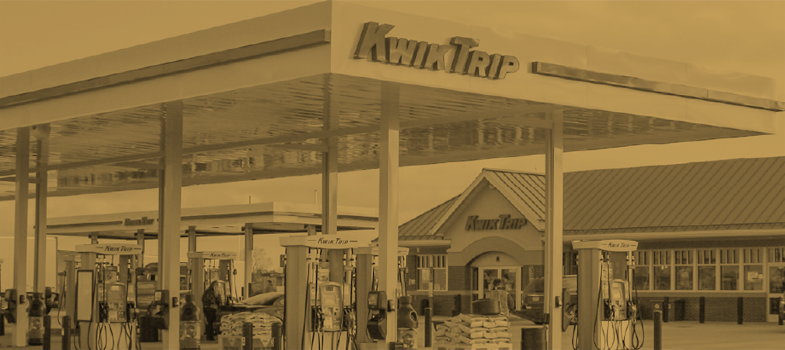
ROUTE A: Business as Usual
Cooper Coefficient: 0.2
It’s easy to tell leadership to stay the course they plotted themselves and previously succeeded with. They’ve spent millions building a brand they’re proud to stand behind. They’ve already spent on this strategy and are still deepening their pockets with it. And that success isn’t based strictly on profit either. In just a few years, Kwik Trip has achieved insider status among the notoriously icy Midwestern crowd. Even if they acknowledge the invisible wall ahead of them, they might think the momentum they’re riding is enough to smash through. Those optimistic leaders are setting their ship up for a spectacular Titanic moment: confidence in unsinkable ships tends to be why they sink.
Staying the course is undeniably the easiest option, but it also does nothing to overcome regional tribalism. There isn’t any real demand for a new convenience store brand, no glaring gap in the market. The East Coast has two regional chains fighting for dominance already and Kwik Trip can’t compete with the spectacle of Buc-ee’s. “Wawa” just sounds right for out East: it has that unmistakable Mid-Atlantic mouthfeel. Even along the West Coast where the market is less dominated, it isn’t that people are underserved. Kwik Trip can’t rely on passive demand from small towns with literally nothing else to justify their slow crawl. Even in areas where similar chains of small towns exist, cheese curds and Charlie Berens jokes won’t break barriers.
That said, this isn’t a total failure of an approach. In an optimistic world, this approach does make some headway beyond the Midwest. Mostly into the rural regions of periphery states where the driving culture and geography matches the U.S. Without changing in a massive way, there’s no reason to predict Kwik Trip succeeds in their national push. I rated this pretty close to 0 (neutral/does nothing) because I don’t think it will actually harm Kwik Trip, but it will quickly prove to have been “too good to be true.” I also think this is a hard position to pivot from. Momentum right now can keep existing fans loyal through a brand transformation, but in another 5 years, any changes to Kwik Trip will be changes to an established cultural artifact, not a rising name. By the time leadership realizes they have to change course, they’ve lost the energy needed to sustain the transformation. National dreams die and holding onto the Midwest becomes priority #1.
ROUTE B: Expanding the Brand
Cooper Coefficient: -0.4
The standard option your generic MBA grad will spit out is to expand the brand: move away from the Midwest and become “cosmopolitan” or some other similarly adorative adjective meaning “not like you are now.” For Kwik Trip, this is brand suicide. Even if Kwik Trip kept its Midwest stores as-is and only employed an expanded brand outside the Midwest, the continuity break would feel like a betrayal. This expansive approach also runs into a more Kwik Trip-specific issue: how reasonable is their degree of vertical integration with a singular, national brand? Can La Crosse, WI produce and supply enough milk to keep Kwik Trip stocked across the country? And more importantly, would what La Crosse can keep on the shelves actually sell outside the region?
I won’t say it’s impossible: eggs and milk are on grocery lists everywhere across the country. Fat, protein, and carbohydrates work the same in every state. Problem is, fuel additives, coolant, and oil don’t. An expanded Kwik Trip needs to expand to supply radically different environments. Maintaining an 80%+ rate of vertical integration while meeting the varied needs of the many Americas would be a feat of modern supply chains. It would also be a potentially massive capital expenditure. Even a single new product needing to go out across the country requires millions in changes, from labeling to the manufacturing setup. Eliminating an option and trying to add it back in later is triply expensive: you pay to get rid of the old stuff, you lose out on that business, and then you have to pay to put everything back in. Expanding Kwik Trip’s brand wouldn’t just be hard to do in terms of semiotics; actually supplying that expansion would be just as difficult.
Most importantly, every step Kwik Trip takes away from its Midwestern roots risks alienating its power center. In trying to appeal elsewhere, Kwik Trip has to move away from its Midwestern culture. The problem is that Kwik Trip doesn’t work as a business without all of its pieces together: take away the spacious layout and you’ve got a cramped deli; take away the regional food options and you’ve got a generic gas station with table space; take away the cultural coding and you’ve got a forgettable rest stop selling gas. Without the ability to play with its pieces, Kwik Trip can’t expand the brand in any way but going generic. Offering less variety to offer a great number of items to cover the expanded needs cripples their integrated strategy in exchange for meeting a demand that’s already met. There’s no lens where this move isn’t potentially harmful with limited ROI. This model can work for many businesses – and has – but not for one so dependent on its culture.
ROUTE C:Regionalize Operations
Cooper Coefficient: .5
Leaning into the invisible wall and using it to draft up corporate regions is the best route for Kwik Trip but also the biggest gamble. Accepting that “Kwik Trip” belongs in the Midwest that shaped it, the corporation can take its business model (vertical integration + cultural integration) and redeploy it across the country. They were already forced into developing this internal infrastructure by a lawsuit with Quik Trip. The brand operates as “Kwik Star” in a few states already. In a fantasy world, they’d launch the three satellite brands in the other three regions all at once. In reality, that would be a level of spending that would collapse the company overnight. They will have to think about this approach in terms of decades, not quarters. That already makes this a challenging sell to change-resistant leadership whose salaries are tied to short-term gains. There are plenty of reasons to bawk at this approach, but it’s logically sound and the only way to keep Kwik Trip’s winning edge while making room for new audiences.
Based on my sociological analysis of driving culture, I’d recommend they focus on the West first. It’s the least crowded competitively, the most similar in driving culture, and most likely to have commercial lots of the size Kwik Trip is used to having. These similarities will ease some of the pressures on the new brand. It doesn’t have to reinvent the wheel entirely nor does it need to fully shift how driving works. Instead, Kwik Trip would need to become “Last Trip” or something along those lines: a bastion of refuge in the wilderness. Instead of luring you off the road to satisfy your cravings now, Kwik Trip’s regional brand in the West needs to highlight the comfort it offers to weary travelers. The challenge isn’t beating out the next small town, it’s that the next small town is through 100mi of nothing.
By leaving Kwik Trip as it is and allowing it to naturally settle into its regional confines, corporate doesn’t need to risk their winning brand. They should still link the brands somehow: whether that’s through a shared naming convention (“Kwik –” or “--- Trip”) or some kind of “Hilton-family” parent company branding I’ll leave up to the focus groups. Doing this allows them to build on the momentum of their Midwestern brand without forcing it to slam into the invisible wall. Instead of breaking through, you show how well you understand the communities you’re part of. By owning their origins and acknowledging that one size does not fit all, Kwik Trip gets to have their cake and eat it too. They can capitalize on the positive semiotics of the Midwest (trustworthy, hardworking, honest) while immersing themselves in the symbols of the given regions. Vertical integration and employee investiture are Midwest business ethics that can succeed anywhere; “come on in” is clearly culturally coded.
Each region has its own hub with its own product lines. Shared products can come from centralized production centers (probably La Crosse given its current status) to help reduce expenditure in regional hubs. Focusing on quick turnover goods locally also allows for greater regional variety where it's most noticeable: the menus can be unique. Positioned correctly, this does two critical things: it reduces the sense of an outsider coming in to exploit the locals (Kwik Trip the Carpetbagger) and it creates immediate buy-in (Kwik Trip the Job Creator.) It isn’t just that they provide gas: they’re building whole supply chains right here, in your backyard.
I would push KT corporate leadership to lean into a shared app and build their own brand story alongside the regional brands. That continuity is the final piece that cements a national brand in its regional legacy. I can hear the “united by quality, flavored by America” branding now. By keeping the app universal, road trips become a question of which Kwik brand stations you’ll be stopping at along the route. You know it’s going to be good and you’ll finally get to try the different food options! Think about the commercial:
You’ve got a young group of friends setting off on a roadtrip together. Parents pack up the back of an old Toyota. “Be careful out there!” warns Dad as Mom gives hugs and the excited friends call from inside the car. “Hurry up, man!” Dad tries to offer a few more words of warning but the kids are off before he can get a word in edgewise. “They’ll be fine,” Mom assures the silent worrier, “he knows where to go.”
Montage cut of the college-bound boys touring one campus after another, stopping at Kwik Trip after Kwik Trip along the way: ordering from Kwik Trip from their hotel room in a small, Ohio town; pouring coolant in in some hot location under the West-branded sign, eating a warm meal at the counter while a Nor'easter storm rages on outside. The phone rings and it’s Dad. “You guys ok? I heard the storms are pretty bad out there.” “We’re fine dad, we’re at Kwik Trip.” The boy laughs as his Dad ends the call and the boys are at ease, plotting their next trip as we blur and fade to the logo. “For everything your road trip needs, everywhere you go. The Kwik Family of Stores.” at the end or playing over the montage scene with the four regional brand logos on screen.
That’s in addition to the localized branding that emphasizes its regional character, quality, options, and voice. This kind of move would allow Kwik Trip to take its meme status and build a national mythology. Actually executing on this strategy will take decades and serious discipline from leadership. If they invested, I do think Kwik Trip could expect to win out. Regional variations linked by a single, national entity is the same as having multiple brand faces in different countries linked by a single, multinational entity. Few companies in the U.S. apply the strategy so openly, but Kwik Trip’s business model is so enmeshed with local culture that they may be forced into it. With forethought and enough time, they could be the ones to prove it’s possible to be local and scale nationally at the same time.
